
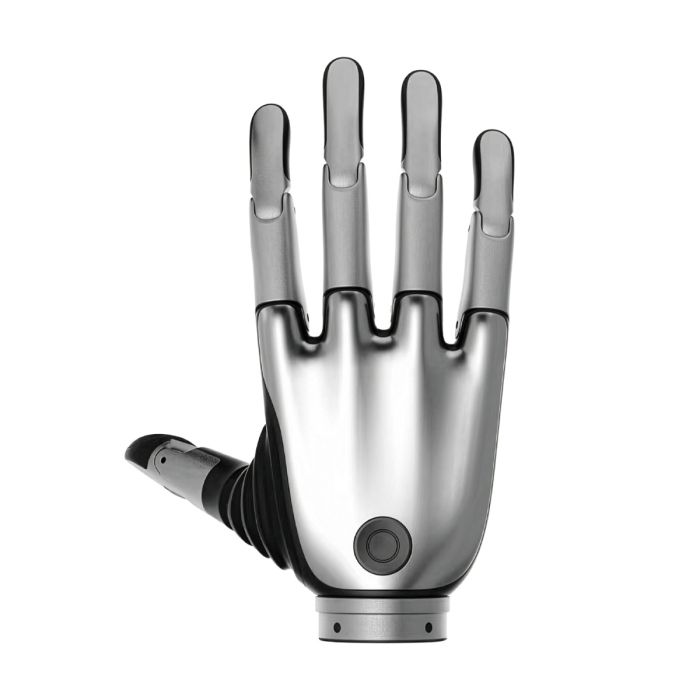
Brainco Revo 2 Touch Biomimetic Dexterous Left Hand (XTL)
In stock
- BRAND:
- BRAINCO
- MODEL:
- REVO 2 TOUCH (LEFT)
- PART #:
- XTL
- ORIGIN:
- China
- AVAILABILITY:
- SUBJECT TO AVAILABILITY
- SKU:
- BrainCo-Revo-2-Touch-Left
Brainco Revo 2 Touch Biomimetic Dexterous Left Hand (XTL)
Six actuators, eleven degrees of freedom: the arithmetic of a dexterous hand is more interesting than its headline numbers. The Brainco Revo 2 Touch Biomimetic Dexterous Left Hand (XTL) is a bionic hand for robot integration and research that reaches 11 degrees of freedom from 6 active joints, and that ratio explains much of how a team should think about it before it reaches the bench.
The product is available through this page, by quotation.
Background
BrainCo and the Revo 2 family
BrainCo is the brand behind the Revo line of bionic hands, and the Revo 2 is the second generation. The family is organised in three versions: Basic (XRL/XRR), Pro (XEL/XER) and Touch (XTL/XTR). The final letter of each code indicates handedness, so this page covers the left hand of the Touch version, code XTL, while the right-hand counterpart carries code XTR.
Readers who want to compare the range can start with the BrainCo Revo 2 category. The first-generation hand, the BrainCo Revo 1 Intelligent Dexterous Bionic Hand, is listed separately on its own page. Those looking at end-effectors from other makers can use the wider Hands category.
Positioning of the Touch version
The Revo 2 is a bionic dexterous hand for robot integration and research. That sets the product's purpose: it is intended to be mounted on a robot arm or humanoid platform and programmed, rather than worn or used as a stand-alone gadget. Within the family, the Touch version is the one named for touch, and it is offered here in the left-hand configuration.
A left hand matters in practice. Bimanual platforms, humanoid research rigs and dual-arm cells need a matched pair, and each hand is addressed and calibrated on its own. Choosing the left hand code XTL, and the right hand code XTR if a pair is required, keeps the two sides of a build consistent within the same version.
Technical Specifications
| Specification | Value |
|---|---|
| Product type | Bionic dexterous hand for robot integration and research |
| Version code | XTL (Touch, left hand); the right-hand code is XTR |
| Active joints | 6 |
| Degrees of freedom | 11 in total |
| Pinch force | ≥15N |
| Control precision | 0.1° |
| Communication interfaces | RS485, CAN FD and EtherCAT |
| SDK support | Linux, Windows and ROS workflows |
| Control and protection | Closed-loop servo control, custom gesture definitions, and protections for current, stall, high temperature and collision conditions |
Specifications as published by the manufacturer; confirmed against the datasheet at quotation.
The manufacturer has not published the IP rating, the package contents, the tactile sensor resolution or the motor type; they are confirmed at quotation.
What makes the Touch version different from the Basic and Pro versions?
The family has three versions, and the version code is the first thing that separates them: XRL/XRR for Basic, XEL/XER for Pro and XTL/XTR for Touch. The Touch version is the one that carries the tactile identity in its name, which makes it the natural candidate for teams whose work is about contact rather than only about motion.
The figures on this page belong to the Touch version: 6 active joints, 11 degrees of freedom, a pinch force of at least 15N and a control precision of 0.1°. This page does not borrow figures from the other versions, and it does not claim that any of these values differ from theirs. A buyer comparing versions can ask for the datasheets side by side at quotation.
For those who do not need the Touch version, the left-hand siblings are the BrainCo Revo 2 Basic Left Dexterous Bionic Hand (XRL) and the BrainCo Revo 2 Pro Dexterous Left Hand (XEL). For a right-hand build in the Touch version, the matching page is the Brainco Revo 2 Touch Biomimetic Dexterous Right Hand (XTR).
How does the Revo 2 Touch connect to a robot controller?
Integration is usually decided by the communication layer before it is decided by the mechanics. The Revo 2 supports three interfaces: RS485, CAN FD and EtherCAT. That range covers a simple serial link for a bench set-up as well as the fieldbuses commonly found in robot cells and humanoid platforms, so the hand does not force a team to redesign its controller architecture around it.
On the software side, the hand comes with SDK support for Linux, Windows and ROS workflows. A team working in ROS can fold the hand into an existing graph, while a laboratory that runs experiments from a Windows workstation, or a robotics group that prefers Linux, has a supported route as well. Custom gesture definitions allow a team to store the hand postures that matter for its task and call them by name instead of recomputing joint targets each time.
Closed-loop servo control and a control precision of 0.1° describe how commands are executed. Protections for current, stall, high temperature and collision conditions are part of the design, which is a practical advantage in research settings where a hand is driven into unfamiliar situations and a failed trial should not damage the hardware.
Who is the Revo 2 Touch (XTL) for?
The first group is robotics research laboratories working on grasping and manipulation. A hand with 11 degrees of freedom driven by 6 active joints allows a range of grasp types to be studied, and the Touch version is the one that suits work in which contact is a subject of study.
The second group is humanoid robot developers. A humanoid needs a matched pair of hands, and the left-hand code XTL pairs with the right-hand code XTR in the same version. Developers who intend to build both sides can quote the two codes together.
The third group is system integrators who add manipulation to a cell or a demonstrator. Their priorities are interfaces and software, and the combination of RS485, CAN FD and EtherCAT with Linux, Windows and ROS support addresses both.
Teams that do not need the tactile version, or that want to begin with a simpler hand, can look at the Basic left hand (XRL) before deciding.
What is the Revo 2 Touch (XTL) used for?
- Grasping research. Studying how a multi-jointed hand forms and holds grasps on a robot arm.
- Humanoid robot hands. Serving as the left hand of a humanoid platform, paired with the right-hand XTR.
- Tactile manipulation studies. Work in which the Touch version's contact capability is part of the experiment.
- Gesture programming. Defining and recalling custom hand postures for repeatable tasks.
- Controller integration trials. Testing the hand over RS485, CAN FD or EtherCAT against an existing control architecture.
- Teaching and demonstration. Showing students and visitors how a bionic hand is commanded through its SDK.
Pricing and Availability
No prices are listed on this page, because each project differs in quantity, version and handedness. Quotation is the way to proceed: send the version code, the number of hands and the intended application, and a quotation is prepared. Delivery, customs and support are arranged with the quotation. The Brainco Revo 2 Touch Biomimetic Dexterous Left Hand (XTL) is available on this page.
Frequently Asked Questions
How many joints and degrees of freedom does the Revo 2 Touch have?
It has 6 active joints and a total of 11 degrees of freedom.
What pinch force and control precision does it offer?
The pinch force is at least 15N and the control precision is 0.1°.
Which communication interfaces are supported?
The hand supports RS485, CAN FD and EtherCAT. The interface for a given project is chosen according to the controller it is connected to.
Which software environments does the SDK cover?
SDK support is provided for Linux, Windows and ROS workflows. Custom gesture definitions are available as well.
What protections does the hand include?
The hand includes closed-loop servo control and protections for current, stall, high temperature and collision conditions.
What is the difference between XTL and XTR?
Both belong to the Touch version. XTL is the left hand and XTR is the right hand, so a bimanual build uses one of each.
Where can I buy the Brainco Revo 2 Touch Biomimetic Dexterous Left Hand (XTL) and what does it cost?
It is available through this page, by quotation. No price is shown here; request a quotation and the cost is provided with the delivery, customs and support arrangements.
Summary
The Revo 2 Touch XTL gets 11 degrees of freedom from 6 active joints, adds a pinch force of at least 15N and a control precision of 0.1°, and connects through RS485, CAN FD or EtherCAT with SDK support for Linux, Windows and ROS. It is a left hand for teams that study contact as well as motion. For a team that has settled on the Touch version and the left-hand configuration, this page is the starting point.
Specifications
General
Physical
Mobility
Performance
Connectivity
Software
Hand
What's included
Videos