
BrainCo Revo 1 Intelligent Dexterous Bionic Hand
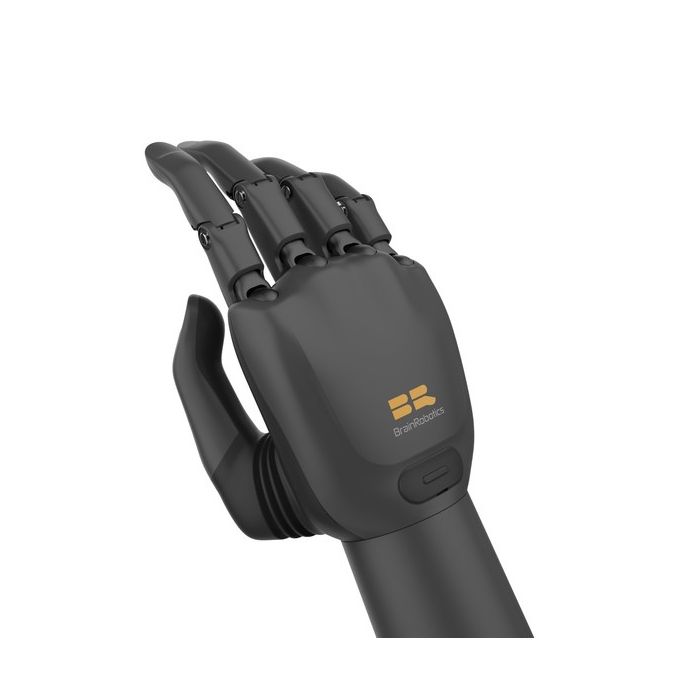
The BrainCo Revo 1 Intelligent Dexterous Bionic Hand is a robotic dexterous hand platform from BrainCo, a brain-computer-interface and human-machine-interface company that publicly lists “BrainCo Bionic Dexterous Hand Revo1” among its product lines on its official website. BrainCo positions itself as a company working across bionic hands, bionic knees, neurotechnology, and AI-oriented robotics solutions.
In stock
- BRAND:
- BRAINCO
- PART #:
- Intelligent Dexterous Bionic Hand
- ORIGIN:
- China
- Warranty:
- 12 MONTHS
- AVAILABILITY:
- SUBJECT TO AVAILABILITY
- SKU:
- BrainCo-Dexterous-Bionic-Hand
Most robotic end-effectors are judged by how firmly they hold. A hand is judged by how well it adapts. The BrainCo Revo 1 Intelligent Dexterous Bionic Hand belongs to the second category: a biomimetic hand whose thumb and fingers are arranged to follow the logic of human anatomy, so that a grasp can conform to an object instead of crushing it.
The product is available through this page, by quotation.
Background
BrainCo and its lineage
BrainCo was, according to the published company description, founded in 2015 and incubated by the Harvard Innovation Lab (i-Lab). It is based in Somerville, Massachusetts, and has focused on developing a non-invasive brain-computer interface (BCI). That origin explains the character of its hardware. A company whose starting point is the link between human intent and machine action naturally builds hands, and the Revo 1 is one of its bionic hand products.
The same published material shows the Revo 1 within a wider family of BrainCo hands. The category page for BrainCo Revo 1 collects the first-generation offering, while later models such as the BrainCo Revo 2 Basic Right Dexterous Bionic Hand (XRR) are listed separately. Software resources from the manufacturer also treat the generations together: a ROS 2 driver is described for Revo 2 and Revo 1 hand control, and Python and C/C++ SDK examples are described for Revo 2 and Revo 1, the Control Glove and the EMG Armband.
Positioning and key technology
The Revo 1 is described as a biomimetic dexterous hand with 6 active joints and 10 degrees of freedom. The difference between those two numbers is the interesting part. According to the published specification, the thumb has two active degrees of freedom, covering abduction/adduction and flexion/extension. Each of the other four fingers has one active and one passive flexion/extension degree of freedom. The passive joint is not driven separately, which lets a finger follow the contour of whatever it meets while the number of motors stays contained.
The hand is offered in public hardware variants named Revo 1 Basic and Revo 1 Advanced, and a Basic Touch SKU is also named. The published material states that tactile sensing depends on the SKU. A buyer who needs touch feedback should therefore state that requirement when requesting a quotation, so that the correct variant is quoted.
Technical Specifications
| Specification | Value |
|---|---|
| Product type | Biomimetic dexterous hand |
| Active joints | 6 |
| Degrees of freedom | 10 |
| Thumb | 2 active degrees of freedom (abduction/adduction, flexion/extension) |
| Other four fingers | Each 1 active and 1 passive flexion/extension degree of freedom |
| Maximum hand load | 30 kg |
| Five-finger grip force | 50 N |
| Control modes | Position and Speed |
| Connector | Model PAP-05V-S, located under the wrist |
| Default device ID | 1, adjustable within 1 to 254 |
| Hardware variants | Revo 1 Basic, Revo 1 Advanced, Basic Touch SKU; tactile sensing depends on the SKU |
| Hand weight | Not published |
| Hand dimensions | Not published |
| IP rating | Not published |
| Box contents | Not published |
| Certifications | Not published |
Specifications as published and reported by a single source; they are confirmed against the datasheet at quotation, as are the weight, dimensions, ingress protection, box contents and certifications, which the manufacturer has not published.
What makes the Revo 1 different from a conventional gripper?
A parallel gripper has one motion: open or close. It is dependable for parts of a known shape, but it has little to offer when the object is irregular, soft or unknown in advance. The Revo 1 addresses that gap through its joint layout. A thumb that moves in two directions can oppose the fingers in more than one way, and four fingers with a driven joint and a passive joint can wrap around an object rather than meet it at two points.
Per the published specification, the hand is rated for a maximum hand load of 30 kg and a five-finger grip force of 50 N. These are two different quantities and should not be read as interchangeable. One describes what the hand can carry, the other how hard the five fingers can press together. Teams planning a task should consider both against the objects involved.
The control side matters equally. The published material lists Position and Speed control modes, so software can place a finger at a target angle or move it at a chosen rate. A turbo mode is also described, based on stall detection. When a finger stalls against an object, it pauses for the configured stall duration and then continues gripping at 500 ms intervals. In practice this gives a held object a repeated, renewed squeeze rather than a single closing action, which is a useful behaviour to understand before designing a handling routine.
How is the Revo 1 integrated and controlled?
The published specification places the interface under the wrist, with the connector model given as PAP-05V-S. After power-on, the hand automatically runs a position calibration sweep, so the integrator should leave the fingers free to move at start-up. The default device ID is 1 and can be changed within the range 1 to 254, which allows several hands to be distinguished on one system. Users can also configure custom LED colours and patterns, a small feature that is useful for showing the state of a hand during demonstrations or multi-unit setups.
For software, the manufacturer's published resources mention a ROS 2 driver covering Revo 2 and Revo 1 hand control, together with Python and C/C++ examples. These examples also cover the Control Glove and the EMG Armband. Buyers who plan teleoperation or myoelectric experiments should ask at quotation which of these accessories and software packages apply to the variant they select, since the fact sheet does not state that.
Who is the Revo 1 for?
Research laboratories are the clearest audience. A hand with a defined joint structure, documented control modes and open software examples is a workable platform for studying grasping, teleoperation and human-machine interaction. Integrators building humanoid or manipulation prototypes can treat it as a human-like end-effector without developing the fingers themselves.
Education and training programmes can use it to teach kinematics, control and sensing in a tangible form. Groups working on assistive technology and rehabilitation-oriented projects may find the biomimetic layout relevant, particularly alongside the manufacturer's wider interest in human-machine interfaces. Organisations in that field may also wish to browse the Medical Robots category.
Buyers who want touch feedback should look at the Touch-equipped option, since tactile sensing depends on the SKU. Those weighing a newer generation can compare the Brainco Revo 2 Touch Biomimetic Dexterous Right Hand (XTR) or the BrainCo Revo 3-21 Basic Robot Hand. The fact sheet gives no comparative figures for these models, so the comparison is best made at quotation.
What is the Revo 1 used for?
- Grasping research. Studying how a multi-joint hand conforms to objects of different shapes.
- Robot end-effector integration. Giving a manipulator arm or humanoid platform a human-like hand.
- Teleoperation experiments. Driving the hand from operator input, using the manufacturer's glove and armband examples where applicable.
- Assistive-technology development. Prototyping and testing hand concepts for people who need support with manipulation.
- Teaching and demonstration. Illustrating kinematics, control modes and sensing in classrooms and laboratories.
- Control software development. Writing and testing position, speed and stall-based gripping behaviour through the available SDK examples.
Pricing and Availability
Pricing depends on the variant, the sensing option and the quantity, so it is provided by quotation and not listed. Please state the intended variant and application in your request. Delivery, customs and support are arranged together with the quotation. The Revo 1 and its options are available on this page.
Frequently Asked Questions
How many joints and degrees of freedom does the Revo 1 have?
The published specification gives 6 active joints and 10 degrees of freedom. The difference arises from the passive flexion/extension joint in each of the four fingers.
What are the load and grip figures?
The published maximum hand load is 30 kg, and the five-finger grip force is 50 N. Both are reported by a single source and are confirmed against the datasheet at quotation.
Which control modes are available?
Position and Speed modes are listed. A turbo mode based on stall detection is also described: a stalled finger pauses for the configured duration and then continues gripping at 500 ms intervals.
Does the hand include tactile sensing?
It depends on the SKU. Revo 1 Basic, Revo 1 Advanced and a Basic Touch SKU are named, and tactile sensing is stated to vary between them.
What software support is available?
The manufacturer's published resources describe a ROS 2 driver and Python and C/C++ examples that cover Revo 1. The exact packages supplied are confirmed at quotation.
What are the weight, dimensions and ingress protection?
The manufacturer has not published the hand weight, dimensions or IP rating, and these are confirmed at quotation. The same applies to box contents and certifications.
Where can I buy the Revo 1 and what does it cost?
It is available through this page by quotation. No price is listed, because the cost depends on the variant and quantity; submit a request and the quotation will follow.
Summary
The Revo 1 is built on the premise that holding an object is a matter of adaptation, not force. Its two-direction thumb, driven and passive finger joints, documented control modes and published software resources make it a considered platform for research, integration, education and assistive-technology work. Several details, including weight, dimensions and certifications, remain unpublished and are confirmed at quotation. For a hand that approaches objects instead of clamping them, this page is the starting point.