
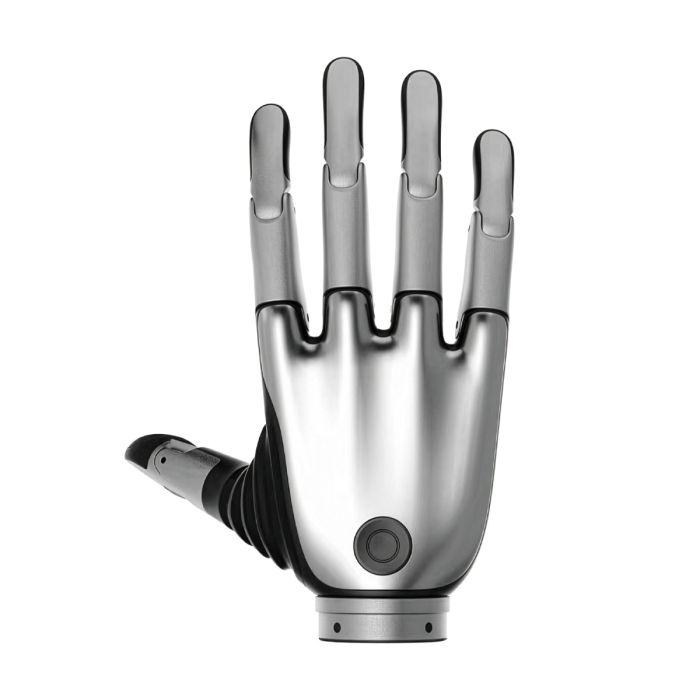
Brainco Revo 2 Touch Biomimetic Dexterous Right Hand (XTR)
In stock
- BRAND:
- BRAINCO
- MODEL:
- REVO 2 TOUCH
- PART #:
- XTR
- ORIGIN:
- China
- AVAILABILITY:
- SUBJECT TO AVAILABILITY
- SKU:
- BrainCo-Revo-2-Touch
Brainco Revo 2 Touch Biomimetic Dexterous Right Hand (XTR)
Every dexterous hand makes a promise with its fingers, but the harder question is what it can tell the rest of the robot. The Brainco Revo 2 Touch Biomimetic Dexterous Right Hand (XTR) is the right-hand model of the Touch version of the Revo 2 family, a bionic dexterous hand for robot integration and research. Its distinguishing feature is a multi-dimensional fingertip tactile module, paired with industrial communication options below the wrist.
The product is available through this page, by quotation.
Background
The company and its lineage
Brainco was founded in 2015 and incubated by the Harvard Innovation Lab (i-Lab). The company is based in Somerville, Massachusetts. The Revo 2 is its second-generation dexterous hand, and it follows the earlier BrainCo Revo 1 Intelligent Dexterous Bionic Hand, which is also listed in this catalogue.
The Revo 2 family is organised in three versions, each with a left and a right hand. Basic is offered as XRL and XRR, Pro as XEL and XER, and Touch as XTL and XTR. The product described here is XTR, the right-hand Touch model. Its mirror image is the Brainco Revo 2 Touch Biomimetic Dexterous Left Hand (XTL).
Positioning and key technology
The Revo 2 is positioned as a bionic hand for robot integration and research. It is not a simple two-jaw gripper. It is a multi-fingered hand intended for work in which the shape and handling of an object matter. The Touch version adds a multi-dimensional fingertip tactile module to this base. That makes it the version for teams that want the hand itself to register contact, not only to close around an object.
Integration has been considered as well. The hand offers RS-485, CAN FD and EtherCAT communication, with the interface located below the wrist. A software development kit supports Python and C and is compatible with Linux, Windows and ROS systems. Current, stall, high-temperature and collision protection are built into the hand. For a research laboratory or a humanoid programme, these are the points that decide how quickly a hand moves from the bench to a working robot.
Technical Specifications
| Specification | Value |
|---|---|
| Product type | Bionic dexterous hand for robot integration and research |
| Version code | XTR (Touch, right hand) |
| Pinch force | ≥15N |
| Control precision | 0.1° |
| Tactile module | Multi-dimensional fingertip tactile module |
| Communication interfaces | RS-485, CAN FD, EtherCAT (located below the wrist) |
| Software | SDK supporting Python and C; compatible with Linux, Windows and ROS |
| Protections | Current, stall, high-temperature and collision protection |
| Default device ID (right hand) | 127 |
| Standard colours | Space Gray, Silver (bulk colour customisation supported) |
Specifications as published by the manufacturer; confirmed against the datasheet at quotation.
The manufacturer has not published the package contents, the ingress protection rating, the tactile sensor resolution or the cable length; they are confirmed at quotation.
What makes the Touch version different from the Basic and Pro versions?
The three versions share the same Revo 2 foundation, and the difference lies in what each adds. In the manufacturer's version table, the multi-dimensional fingertip tactile module is listed for the Touch version. It is not listed for Basic. A team that needs the hand to sense contact at the fingertip should therefore look at the Touch version first. A team that needs only motion and grip can compare it with the BrainCo Revo 2 Basic Right Dexterous Bionic Hand (XRR) or the BrainCo Revo 2 Pro Dexterous Right Hand (XER).
The manufacturer describes the advanced and tactile versions as supporting three communication interfaces: 485, CAN FD and EtherCAT. The XTR therefore suits controllers built around any of these buses. The quotation stage is the right time to confirm which interface suits your architecture, and how the hand is addressed on it.
How does the XTR fit into a robot's control system?
A hand is only useful if it can be commanded predictably. The XTR is controlled through the interface below the wrist, and the SDK covers Python and C on Linux, Windows and ROS. A laboratory already working in ROS can therefore bring the hand into an existing workflow, and a team writing its own firmware can work in C.
Addressing is a practical point on a two-handed robot. For Revo 2, the default device ID is 126 for the left hand and 127 for the right. The XTR ships as the right hand with ID 127, which keeps it distinct from its left-hand partner on a shared bus. The control precision of 0.1° and the pinch force of ≥15N describe what the hand can be asked to do. The current, stall, high-temperature and collision protections limit what can go wrong when a test does not go as planned. That matters during early experiments, when a poorly tuned grasp is more likely than a perfect one.
Who is the Brainco Revo 2 Touch Right Hand (XTR) for?
The first group is humanoid robot developers who need a right hand with tactile sensing at the fingertips and a standard industrial bus. The second is university and corporate research laboratories studying manipulation, grasp control and tactile feedback, where the SDK and ROS compatibility shorten the path to a first experiment. The third is integrators building demonstration or pilot systems who want protections built into the hand rather than added around it.
Buyers who do not need fingertip sensing may be better served by another version. The Pro right hand (XER) and the Basic right hand (XRR) are the alternatives within the family, and the Touch left hand (XTL) completes the pair for a left-hand position. Other end effectors are listed in the Hands category, and related platforms in the Research Robots category.
What is the Brainco Revo 2 Touch Right Hand (XTR) used for?
- Humanoid robot hands: a right-hand end effector with tactile sensing for humanoid platforms.
- Manipulation research: a platform for studying grasping and handling, with a control precision of 0.1°.
- Tactile sensing studies: experiments that use the multi-dimensional fingertip tactile module to observe contact.
- Controller and bus integration: development over RS-485, CAN FD or EtherCAT from a Linux, Windows or ROS environment.
- Bimanual set-ups: work with a matched left hand, using the separate default device IDs of 126 and 127.
- Teaching and demonstration: laboratory and showcase work in which the hand's protections reduce the risk of damage.
Pricing and Availability
No price is listed on this page. Quotation is the way to buy the XTR, and your requirements for quantity, colour and interface can be stated in the request. Delivery, customs and support are arranged with the quotation. The Brainco Revo 2 Touch Biomimetic Dexterous Right Hand (XTR) is available on this page.
Frequently Asked Questions
What is the Brainco Revo 2 Touch Right Hand (XTR)?
It is the right-hand model of the Touch version of the Revo 2 family, a bionic dexterous hand for robot integration and research. It carries a multi-dimensional fingertip tactile module.
Which communication interfaces does it support?
It supports RS-485, CAN FD and EtherCAT. The interface is located below the wrist.
Which software and operating systems are supported?
The SDK supports Python and C. It is compatible with Linux, Windows and ROS systems.
What protections does the hand include?
It includes current protection, stall protection, high-temperature protection and collision protection.
What is the default device ID of the right hand?
The default ID for the right hand is 127, and the default ID for the left hand is 126.
Which colours are available?
The standard colours are Space Gray and Silver. Bulk colour customisation is supported.
Where can I buy the Brainco Revo 2 Touch Right Hand (XTR) and what does it cost?
It is available through this page, by quotation. No price is published here, so please submit a request and the quotation will cover the terms.
Summary
A dexterous hand is judged by what it senses and how readily it joins the robot's control system. The XTR answers both. Its fingertip tactile module, a pinch force of ≥15N, a control precision of 0.1°, three communication interfaces and built-in protections make it a considered choice for research and humanoid work. The SDK and ROS compatibility keep integration practical. For a quotation on the Brainco Revo 2 Touch Biomimetic Dexterous Right Hand (XTR), this page is the starting point.
Specifications
General
Physical
Mobility
Performance
Connectivity
Software
Hand
Shipping
What's included
Videos