
BrainCo Revo 2 Pro Dexterous Left Hand (XEL)
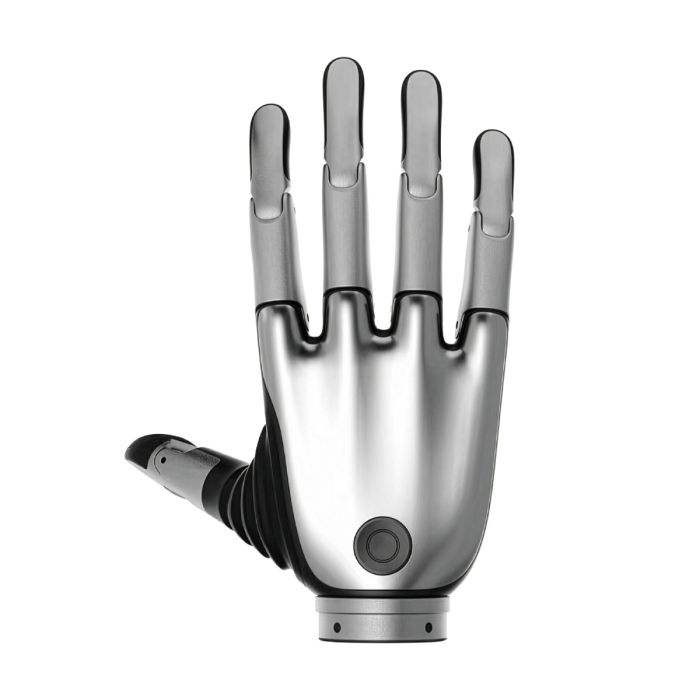
In stock
- BRAND:
- BRAINCO
- MODEL:
- REVO 2 PRO
- PART #:
- XEL
- ORIGIN:
- China
- AVAILABILITY:
- SUBJECT TO AVAILABILITY
- SKU:
- BrainCo-Revo-2-Pro-Left
BrainCo Revo 2 Pro Dexterous Left Hand (XEL)
A robot arm can place a wrist anywhere in its workspace, yet the task is won or lost where fingers meet the object. The BrainCo Revo 2 Pro Dexterous Left Hand (XEL) is designed for that last stage: a bionic left hand with six active joints, closed-loop servo control and a set of industrial communication interfaces, intended for robot integration and research.
The product is available through this page, by quotation.
Background
The Revo 2 series and the Pro version
BrainCo describes the Revo 2 as a bionic dexterous hand for robot integration and research. The series is offered in three versions: Basic (XRL/XRR), Pro (XEL/XER) and Touch (XTL/XTR). In each pair, the codes distinguish the left hand from the right hand. The unit on this page, XEL, is the left-hand Pro configuration, and its mirror-image counterpart is the BrainCo Revo 2 Pro Dexterous Right Hand (XER).
Buyers who wish to see the whole family side by side can browse the BrainCo Revo 2 category. Handedness matters in practice: a bimanual platform needs a true left hand rather than a mirrored fixture, so that each side of the robot is served by a hand built for it.
Positioning and key technology
The Revo 2 is built around 6 active joints that together provide a total of 11 degrees of freedom. Some joints are therefore coupled rather than individually driven, which is a common way to obtain a rich range of hand postures without a motor for every joint. The result is a hand that can form varied grasps while keeping the control problem manageable for the integrator.
Control is closed-loop servo control, with a stated control precision of 0.1°. Custom gesture definitions allow a team to store the postures its application needs. Four protections complete the design: current protection, stall protection, high-temperature protection and anti-collision protection. For a hand that will be commanded repeatedly by researchers who are still tuning their software, these safeguards are as relevant as the joint count.
Communication is offered over RS485, CAN FD and EtherCAT, and the software side is covered by SDK support for Linux, Windows and ROS workflows. Together these choices place the hand in laboratories that work in ROS as well as in cells built around industrial fieldbus equipment.
Technical Specifications
| Specification | Value |
|---|---|
| Version code | XEL (left hand); the Pro version is coded XEL/XER |
| Active joints | 6 |
| Degrees of freedom | 11 in total |
| Pinch force | ≥15N |
| Control precision | 0.1° |
| Control | Closed-loop servo control, custom gesture definitions |
| Protections | Current, stall, high-temperature and anti-collision protection |
| Communication interfaces | RS485, CAN FD, EtherCAT |
| SDK support | Linux, Windows and ROS workflows |
| Standard colours | Space Gray, Silver (bulk colour customisation supported) |
Specifications as published by the manufacturer; confirmed against the datasheet at quotation.
The manufacturer has not published the weight of the Pro version, the IP rating, the box contents, the cable length or the certifications; they are confirmed at quotation.
What makes the Pro version a good fit for integration work?
The case for the XEL rests on how many of an integrator's early questions it answers. A hand that offers three communication interfaces lets a team choose the one that matches its existing controller rather than redesign the controller around the hand. RS485 and CAN FD suit compact, embedded wiring, while EtherCAT suits cells already organised around that fieldbus.
The protective behaviours also bear on the integration effort. Current protection and stall protection limit the stress placed on the drive when a finger is blocked, high-temperature protection guards against sustained load, and anti-collision protection addresses unexpected contact. During commissioning, when trajectories are rough and contact is frequent, these features reduce the risk of damaging the hand or the part.
The Pro version carries the code XEL/XER, and the sources identify it as one of three tiers beside Basic and Touch. The fact sheet we hold does not itemise the differences between the tiers, so a buyer comparing them should request a version-by-version comparison with the quotation. Those who want to examine the alternatives can look at the BrainCo Revo 2 Basic Left Dexterous Bionic Hand (XRL) and the Brainco Revo 2 Touch Biomimetic Dexterous Left Hand (XTL).
Which software and interfaces does the XEL support?
On the software side, the manufacturer provides SDK support for Linux, Windows and ROS workflows. That coverage means a research group can work in the environment it already uses, whether the development machine runs Windows or a Linux distribution, and whether the robot's software stack is built on ROS.
On the hardware side, the three interfaces are RS485, CAN FD and EtherCAT. A project that begins on a bench with a simple serial link can later move to a faster bus without changing the hand. The 0.1° control precision and the option to define custom gestures give the programmer a fine-grained command space, and the closed-loop servo control keeps the commanded posture and the actual posture in step.
Who is the BrainCo Revo 2 Pro Dexterous Left Hand (XEL) for?
Research laboratories are the first audience. A group studying grasping, teleoperation or manipulation learning needs a hand that is documented, scriptable and tolerant of experimental software. The SDK coverage and the protections suit that setting.
Robot integrators and humanoid developers form the second audience. They need a left hand that matches a right hand on the same platform, and they choose hardware by the interfaces it exposes. For them, pairing the XEL with the Pro right hand (XER) keeps both sides of the robot on the same version.
Teams with a lighter requirement may find the Basic version sufficient, and those who want the tactile orientation implied by the Touch name may prefer that tier; both can be discussed during quotation. Further hand options are gathered under Hands.
What is the BrainCo Revo 2 Pro Dexterous Left Hand (XEL) used for?
- Robot integration. Fitting a human-scaled left hand to a robot arm or humanoid platform that must handle everyday objects.
- Manipulation research. Studying grasp strategies with 11 degrees of freedom and 0.1° control precision.
- Teleoperation experiments. Mapping an operator's gestures onto a robotic hand through the SDK and the stored custom gestures.
- Bimanual tasks. Pairing the left hand with a right hand so that one side holds a part while the other works on it.
- Software development. Building and testing control code in Linux, Windows or ROS workflows.
- Teaching and demonstration. Showing students how a closed-loop, protected robotic hand behaves under load and contact.
Pricing and Availability
No price is shown on this page. A quotation is the way to proceed: tell us the quantity, the intended communication interface and any colour requirement, and we will respond with the details for the BrainCo Revo 2 Pro Dexterous Left Hand (XEL). Delivery, customs and support are arranged with the quotation. The product is available on this page.
Frequently Asked Questions
Is the XEL a left hand or a right hand?
The XEL is the left-hand unit of the Pro version. The right-hand unit is coded XER.
How many joints and degrees of freedom does it have?
It has 6 active joints and a total of 11 degrees of freedom.
What pinch force and control precision are stated?
The pinch force is stated as ≥15N and the control precision as 0.1°.
Which communication interfaces are supported?
The hand supports RS485, CAN FD and EtherCAT communication interfaces.
Which software environments are covered?
SDK support is provided for Linux, Windows and ROS workflows.
What protections does the hand include?
It includes current protection, stall protection, high-temperature protection and anti-collision protection, alongside closed-loop servo control and custom gesture definitions.
Where can I buy the BrainCo Revo 2 Pro Dexterous Left Hand (XEL) and what does it cost?
It is available through this page by quotation. The cost is confirmed in the quotation once your requirements are known, and no price is listed here.
Summary
The last stage of a robot arm is where a task is won or lost, and the BrainCo Revo 2 Pro Dexterous Left Hand (XEL) is built for that stage. It offers 6 active joints, 11 degrees of freedom, a pinch force of ≥15N and 0.1° control precision, with four protections, three communication interfaces and SDK support for Linux, Windows and ROS. For a team that needs a documented left hand for integration or research, this page is the starting point.
Specifications
General
Physical
Mobility
Performance
Connectivity
Software
Hand
Feature
1. High quality and stability – five years of product iteration and professional production lines.
2. Lightweight (383 grams), with 5 kg active grip force, 20 kg single-hand load capacity, and a grip-to-weight ratio of 53.
3. Ergonomic Bionic Design – supports curved surface grasping with anti- collision finger design.
4. Multi-dimensional tactile perception – pressure, friction, direction, proximity, and surface texture.
5. High Sensitivity Tactile Perception – max resolution of 0.01N.
6. Wide voltage support – 64V.
7. Universal Interfaces – RS485 & CAN-FD, and EtherCAT.
8. Standard Protocols and SDKs – Modbus & Protobuf protocols, SDKs for Python / C / ROS.