
BrainCo Revo 2 Basic Right Dexterous Bionic Hand (XRR)
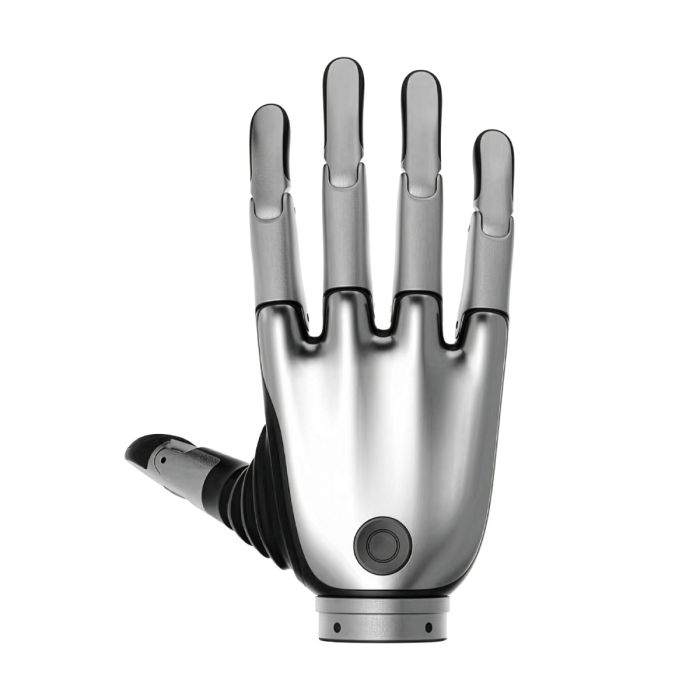
In stock
- BRAND:
- BRAINCO
- MODEL:
- REVO 2 BASIC
- PART #:
- XRL/XRR
- ORIGIN:
- China
- Warranty:
- 12 MONTHS
- AVAILABILITY:
- SUBJECT TO AVAILABILITY
- SKU:
- BrainCo-Revo-2-Basic
BrainCo Revo 2 Basic Right Dexterous Bionic Hand (XRR)
A robot arm can be positioned with great precision, yet the work is ultimately done by whatever sits at its end. When that part is a simple gripper, much of the arm's capability goes unused. The BrainCo Revo 2 Basic Right Dexterous Bionic Hand (XRR) is aimed at that gap: a right-handed, multi-joint hand intended for robot integration and research, offered in the entry configuration of the Revo 2 family.
The product is available through this page, by quotation.
Background
BrainCo and the Revo 2 line
BrainCo is the manufacturer of the Revo 2 range. According to the published source, the Revo 2 is a bionic dexterous hand for robot integration and research. The range is sold in three configurations, identified by version codes: Basic (XRL for the left hand, XRR for the right), Pro (XEL and XER) and Touch (XTL and XTR). The fact sheet for this product does not describe the company's history in detail, so this page does not attempt to do so.
What the sources do establish is the structure of the family. Each configuration is offered as a left and a right hand, and the version code tells a purchaser which configuration and which side is being specified. For a team building a two-handed platform, this means both hands can be ordered from the same line, with matching codes for each side.
Positioning of the Basic configuration
The Basic configuration is the starting point of the Revo 2 family. The XRR variant on this page is the right-hand version. Its published parameters centre on the mechanical layout and the electrical interface: 11 degrees of freedom, of which 6 are active, and a communication connector located under the wrist. Further detail on sensing and higher-tier features belongs to the Pro and Touch configurations, and those should be checked against their own pages rather than assumed for the Basic hand.
The hand is described by its manufacturer as suited to both integration and research. In practice this covers two audiences: engineers who need a hand to fit into a robot platform, and laboratories that need a hand on which to test grasping and manipulation methods.
Technical Specifications
| Specification | Value |
|---|---|
| Product type | Bionic dexterous hand for robot integration and research (single source) |
| Version | Basic |
| Version code (this product) | XRR (right hand); the left-hand Basic code is XRL |
| Degrees of freedom | 11 (6 active), per the published specification |
| Communication interface connector | BM05B-PASS-TFT(LF)(SN), located under the wrist, per the published specification |
| Default device ID | 127 for the right hand (126 for the left hand), per the published specification |
| IP rating | Not published by the manufacturer |
| Dimensions with wrist | Not published by the manufacturer |
| Flexion/extension lifespan | Not published by the manufacturer |
| Battery | Not published by the manufacturer |
Specifications as published; confirmed against the datasheet at quotation. Where a value is listed as not published, the manufacturer has not released it, and it is confirmed at quotation.
What does 11 degrees of freedom with 6 active joints mean?
The published figure is 11 degrees of freedom, with 6 of them active. The distinction is worth understanding before a purchase. Active degrees of freedom are those driven directly, while the remaining ones move as a consequence of the mechanical design, following the driven joints. A hand built this way can reproduce a range of finger postures without needing a separate actuator for every joint.
For an integrator, the practical consequence is the number of channels that must be commanded. Six active joints define the control problem, while the full eleven degrees of freedom describe the range of shapes the hand can take. The fact sheet does not state how each of the joints is coupled, so a team that needs that detail for modelling should request it from the datasheet at quotation.
This is the kind of figure that should be read in context. It tells you the hand is a genuine multi-finger design rather than a two-jaw gripper, but it does not by itself say how much force the hand can apply or how finely it can position a fingertip. Those values are not in the fact sheet and are not stated here.
How does the Basic hand connect to a robot?
The communication interface is located under the wrist, and the connector model is BM05B-PASS-TFT(LF)(SN), per the published specification. A named connector matters because it lets a team prepare cabling and mounting before the hand arrives, instead of discovering a mismatch at installation.
Each hand also carries a default device ID: 126 for the left hand and 127 for the right. This is useful when two hands share one communication bus. The right-hand XRR on this page ships with the default ID of 127, so a pair of Revo 2 hands can in principle be told apart without any reconfiguration. Whether the ID can be changed, and by what method, is not covered in the fact sheet, and should be confirmed at quotation.
The fact sheet does not list the electrical supply requirement, the protocol details or the software tools for this configuration. They are therefore not described here, and a buyer should ask for the datasheet for these points.
Who is the BrainCo Revo 2 Basic Right Hand for?
The Basic right hand is intended for buyers who need a dexterous hand and who will be doing the integration work themselves. Three groups stand out.
Robotics researchers form the first. A laboratory studying grasping, in-hand manipulation or teleoperation needs a hand with enough joints to produce varied postures, and a documented connector and device ID make bench set-up more predictable.
The second group is robot builders. Teams developing humanoid or arm-based platforms can use the hand as the end effector on the right side. Those who also need a left hand can look at the BrainCo Revo 2 Basic Left Dexterous Bionic Hand (XRL), which is the matching Basic configuration for the other side.
The third group is buyers who need more than the Basic configuration offers. The fact sheet names Pro and Touch versions, but it gives no figures that distinguish them from the Basic hand, so this page does not claim what they add. Those who want to compare can review the BrainCo Revo 2 Pro Dexterous Right Hand (XER) or the Brainco Revo 2 Touch Biomimetic Dexterous Right Hand (XTR) directly.
Buyers who simply want to browse similar products can start from the Hands category, or from the BrainCo Revo 2 range page.
What is the BrainCo Revo 2 Basic Right Hand used for?
- Robot integration. Fitting a right-hand end effector to an arm or a humanoid platform.
- Grasping research. Testing grasp strategies on a hand with multiple fingers and joints.
- Manipulation studies. Exploring how finger posture affects the handling of varied objects.
- Teleoperation experiments. Giving an operator a hand-shaped end effector to control remotely.
- Dual-hand platforms. Pairing a right hand with its left-hand Basic counterpart, using the separate default IDs of 127 and 126.
- Teaching and demonstration. Showing students and visitors how a bionic hand is built and commanded.
Pricing and Availability
No price is published on this page. Quotation is the route to purchase: send a request stating the version code, the quantity and the intended application, and the quotation will address them. Delivery, customs and support are arranged with the quotation. The BrainCo Revo 2 Basic Right Dexterous Bionic Hand (XRR) is available on this page.
Frequently Asked Questions
What is the version code of this hand?
The version code is XRR, which denotes the Basic configuration in the right-hand form. The left-hand Basic code is XRL, according to the published specification.
How many degrees of freedom does it have?
The published specification gives 11 degrees of freedom, of which 6 are active. Details of how the joints are coupled are not in the fact sheet.
Where is the communication interface?
It is located under the wrist, and the connector model is BM05B-PASS-TFT(LF)(SN), as reported in the published specification.
What is the default device ID?
The default ID for the right hand is 127, and for the left hand it is 126, per the published specification. This allows two hands to coexist on one bus.
Is the hand waterproof or dust-resistant?
The manufacturer has not published an IP rating. It is confirmed at quotation, and the hand should not be assumed to be protected against water or dust.
What are the dimensions, lifespan and battery details?
The manufacturer has not published the dimensions with wrist, the flexion/extension lifespan or any battery information. These are confirmed at quotation against the datasheet.
Where can I buy the BrainCo Revo 2 Basic Right Dexterous Bionic Hand (XRR) and what does it cost?
It is available through this page by quotation. No price is shown; submit a request and the cost is provided in the quotation, together with delivery, customs and support arrangements.
Summary
A robot is only as capable as the hand that meets the work, and the BrainCo Revo 2 Basic Right Dexterous Bionic Hand (XRR) is the right-handed, entry-level answer within its family. Its published strengths are structural: 11 degrees of freedom with 6 active, a named connector under the wrist and a default device ID of 127 for straightforward bus identification. The gaps are equally clear, since the IP rating, dimensions with wrist, lifespan and battery details are unpublished and are settled at quotation. For a buyer who wants a documented starting point for integration or research, this page is the starting point.