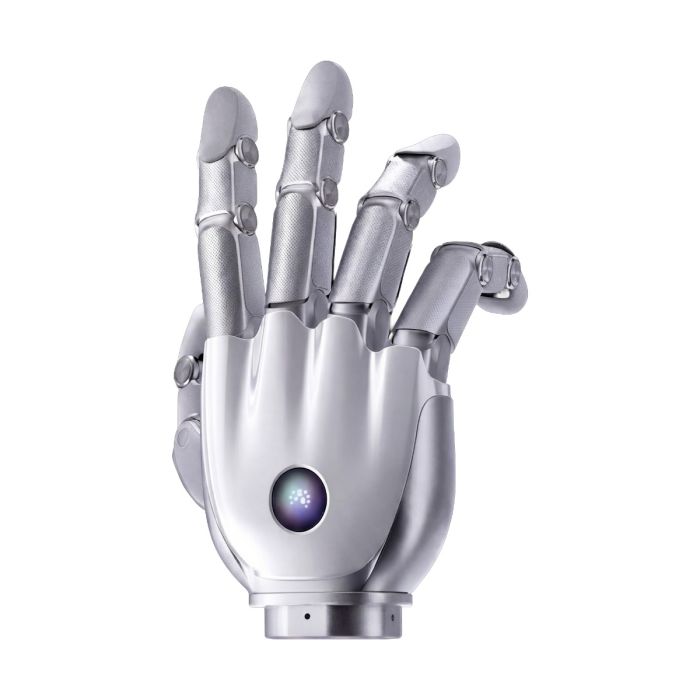
BrainCo Revo 3-21 V-Touch Robot Hand
In stock
- BRAND:
- BRAINCO
- MODEL:
- REVO 3-21 V-TOUCH
- ORIGIN:
- China
- Warranty:
- 12 MONTHS
- AVAILABILITY:
- SUBJECT TO AVAILABILITY
- SKU:
- BrainCo-Revo-3-V-Touch
BrainCo Revo 3-21 V-Touch Robot Hand
A hand is only as useful as what it knows once the fingers have closed. Many robotic grippers can apply force, but few can tell a controller where the contact is, how it is changing and whether the object is about to slip. The BrainCo Revo 3-21 V-Touch Robot Hand is built around that question: a biomimetic dexterous hand with direct-driven, backdrivable joints, a piezoresistive palm array and vision-tactile sensing at the fingertips, so the control system receives contact information as well as position.
The product is available through this page, by quotation.
Background
The Revo line and the V-Touch version
The Revo 3 is a biomimetic dexterous hand from BrainCo, designed for industrial automation, scientific research and advanced robotics manipulation. It comes in four versions: Revo 3 U21, Revo 3 U21F, Revo 3 U21T and Revo 3 U21VT. This page concerns the V-Touch hand, and every figure below belongs to the Revo 3 U21VT; no figure from another version has been carried over.
Buyers who wish to compare generations will also find earlier BrainCo hands in the store, such as the Brainco Revo 2 Touch Biomimetic Dexterous Right Hand (XTR). The Revo 3 should be judged on its own specification, as set out in this article.
Positioning and key technology
The Revo 3 is positioned as a research and automation hand rather than a simple two-state gripper. It has 21 degrees of freedom, distributed as four DoF in each of the four fingers and five DoF in the thumb. The joints are direct-driven and backdrivable, which means the hand can be moved by external force instead of resisting it, a useful property when a hand meets an unexpected obstacle or is guided by hand during teaching.
The V-Touch designation refers to the sensing. The palm carries a piezoresistive array of 336 points, and the fingertips use vision-tactile sensing with 2000 markers. The tactile force range is 0–20 N with a resolution of 0.01 N. The hand is supported by cross-platform C/C++ and Python SDKs for Linux and Windows, and it connects over EtherCAT, CAN FD or RS-485.
Technical Specifications
| Specification | Value (Revo 3 U21VT) |
|---|---|
| Total degrees of freedom | 21 (direct-driven and backdrivable) |
| DoF distribution | Four fingers × 4 DoF, thumb × 5 DoF |
| Hand dimensions | 216 × 108 × 50 mm |
| Supply voltage | 16–85 V |
| Max current | 10 A (24 V) |
| Max active grip force | ≥100 N |
| Max fingertip pinch force | ≥25 N |
| Total hand payload | 20 kg |
| Four-finger payload | 5 kg |
| Repeatability | 0.1° |
| Joint open/close time | 0.33 s |
| Communication interface | EtherCAT / CAN FD / RS-485 |
| Communication frequency | 500 Hz |
| Onboard sensors | IMU (mainboard), temperature (mainboard) |
| Tactile type | Palm piezoresistive array + fingertip vision-tactile |
| Tactile array | 336 points (piezoresistive) + 2000 markers (vision-tactile) |
| Tactile force range | 0–20 N |
| Tactile resolution | 0.01 N |
| Durability rating | Over 1,000,000 joint flex cycles |
| Motion ability | Full score on the Kapandji opposition test; covers 33 grasp types (Feix GRASP taxonomy) |
| Software | C/C++ and Python SDKs, Linux and Windows |
Specifications as published by the manufacturer; confirmed against the datasheet at quotation.
The manufacturer has not published the weight, the IP rating, the operating temperature range, the package contents or the hand-only mass without the wrist; they are confirmed at quotation.
What makes the V-Touch different from the other Revo 3 versions?
Among the four Revo 3 versions, the difference that matters most for this hand is tactile sensing. The V-Touch combines a palm piezoresistive array with fingertip vision-tactile sensing. The tactile force range of 0–20 N and the resolution of 0.01 N are listed for this version, together with 336 palm points and 2000 fingertip markers.
Where an application needs only motion and force, a simpler version may be enough. Buyers can review the BrainCo Revo 3-21 Basic Robot Hand and the BrainCo Revo 3-21 Touch Robot Hand and compare their sensing against the needs of the project. The V-Touch is the version to consider when the research question or the process depends on understanding contact in detail, not only on closing the hand.
Why do direct-driven, backdrivable joints matter?
In a hand with high-ratio transmissions, an external knock is transmitted into the mechanism and can damage it, and the controller has little sense of what the finger has encountered. A direct-driven, backdrivable joint behaves differently: the finger can yield when pushed and the motor reflects what the joint is experiencing. For teams working on compliant control, teleoperation or learning from demonstration, this behaviour makes interaction with real objects more forgiving.
The remaining figures support that use. The hand closes or opens a joint in 0.33 s, repeats positions to 0.1°, communicates at 500 Hz and is rated for over 1,000,000 joint flex cycles. It has also scored fully on the Kapandji opposition test and covers 33 grasp types in the Feix GRASP taxonomy, which indicates the range of postures available to a planner. The active grip force is at least 100 N, and the fingertip pinch force is at least 25 N.
For power, the guidance is to use a stable 24 V DC supply rated at no less than 100 W, which reduces the risk of voltage drop. The maximum current is 10 A at 24 V.
Who is the BrainCo Revo 3-21 V-Touch Robot Hand for?
Research laboratories are the most natural buyers. Teams studying manipulation, tactile perception or learning-based control gain a hand that returns force-related data from both palm and fingertips, with SDKs in languages they already use.
Developers of humanoid and mobile manipulation platforms form a second group. The 216 × 108 × 50 mm size, the choice of EtherCAT, CAN FD or RS-485, and the 500 Hz communication frequency suit integration into a wider control architecture.
Industrial automation engineers who handle delicate, irregular or variable parts will find the tactile layer relevant for process development. Teams that do not need touch sensing should compare the Basic and Touch versions before deciding.
What is the BrainCo Revo 3-21 V-Touch Robot Hand used for?
- Dexterous manipulation research. 21 degrees of freedom and 33 grasp types give a broad space for studying in-hand movement.
- Tactile perception studies. Palm and fingertip sensing supply contact data for contact localisation and slip research.
- Teleoperation and demonstration. Backdrivable joints suit hand-guided teaching and operator-driven control.
- Humanoid robot development. A multi-fingered end-effector for platforms that need human-like interaction with objects.
- Industrial handling trials. Evaluating delicate or irregular parts where grip needs to adapt to what the hand feels.
- Software and control development. C/C++ and Python SDKs on Linux and Windows support algorithm work and integration.
Pricing and Availability
Pricing is provided by quotation. Delivery, customs and support are arranged with the quotation. The BrainCo Revo 3-21 V-Touch Robot Hand is available on this page.
Frequently Asked Questions
How many degrees of freedom does the hand have?
The Revo 3 U21VT has 21 degrees of freedom, all direct-driven and backdrivable. Each of the four fingers has 4 DoF and the thumb has 5 DoF.
What tactile sensing does the V-Touch version include?
It has a palm piezoresistive array of 336 points and fingertip vision-tactile sensing with 2000 markers. The tactile force range is 0–20 N, with a resolution of 0.01 N.
Which communication interfaces are supported?
The hand supports EtherCAT, CAN FD and RS-485, with a communication frequency of 500 Hz.
Which software tools are available?
Cross-platform C/C++ and Python SDKs are provided, compatible with Linux and Windows.
What power supply should be used?
A stable 24 V DC supply rated at no less than 100 W is recommended. The listed supply voltage is 16–85 V and the maximum current is 10 A at 24 V.
What payload and grip force does the hand offer?
The total hand payload is 20 kg and the four-finger payload is 5 kg. The maximum active grip force is at least 100 N and the fingertip pinch force is at least 25 N.
Where can I buy the BrainCo Revo 3-21 V-Touch Robot Hand and what does it cost?
It is available through this page, by quotation. No price is listed; request a quotation and the terms, including delivery and support, are provided with it.
Summary
A hand that closes without feeling is a blunt tool; one that reports contact gives a project something to work with. The BrainCo Revo 3-21 V-Touch Robot Hand pairs 21 backdrivable degrees of freedom with palm and fingertip tactile sensing, a 0.1° repeatability, EtherCAT, CAN FD and RS-485 connectivity, and SDKs for Linux and Windows. For teams in which contact information matters as much as grip, this page is the starting point.